Beschrijving
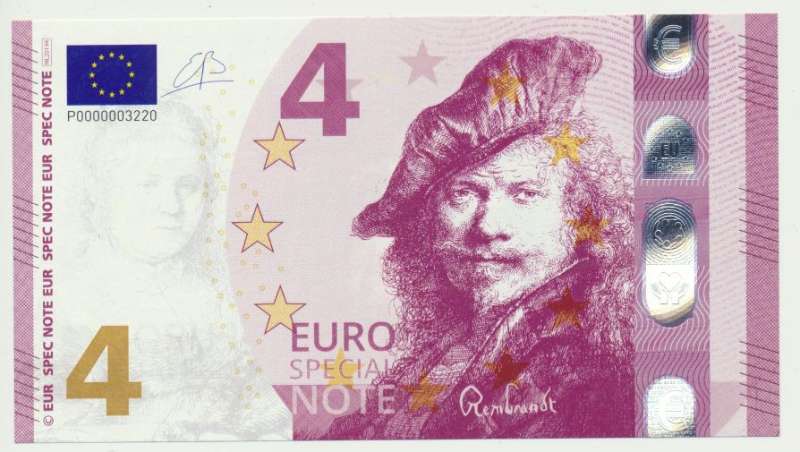
Europe 4 Euro 2019 Rembrandt bill
Circulation:7500 pieces.
This Euro Special Note bill is dedicated to Rembrandt van Rijn.
The year 2019 is dedicated to Rembrandt van Rijn: as it is 350 years since Rembrandt died. In the years after his death, Rembrandt lives on through his paintings, with The Night Watch being the most famous painting. And now a collector's bill dedicated to Rembrandt van Rijn.
Many of Rembrandt's paintings can be seen at museums in Amsterdam: the Rijksmuseum (with the Night Watch) and the Rembrandt House.
About the painter Rembrandt
Rembrandt Harmenszoon van Rijn was born in Leiden on July 15, 1606, and died in Amsterdam on October 4, 1669. By that time, he was also a well-known Dutch painter, etcher and draughtsman. He is considered one of the greatest painters and etchers in European art, and the most important Dutch master of the 17th century.
Rembrandt was very prolific. As far as we know, he produced around 300 paintings, 300 etchings and 2,000 drawings. Rembrandt van Rijn is known for his play with light and dark, often using sharp contrasts to draw the viewer into the scene. This led to vivid scenes full of drama. Paintings by Rembrandt are still occasionally discovered.
The front of this Euro Special Note depicts not only Rembrandt but also his first wife Saskia van Uylenburgh. She was an inspiration to Rembrandt and can be seen in many paintings and drawings. Their son Titus van Rijn and housekeeper/later friend Hendrickje Stoffels also feature in Rembrandt's paintings; they have functioned for portraits of themselves as well as models for Biblical, mythological or historical figures. Rembrandt also did many self-portraits.
The Night Watch
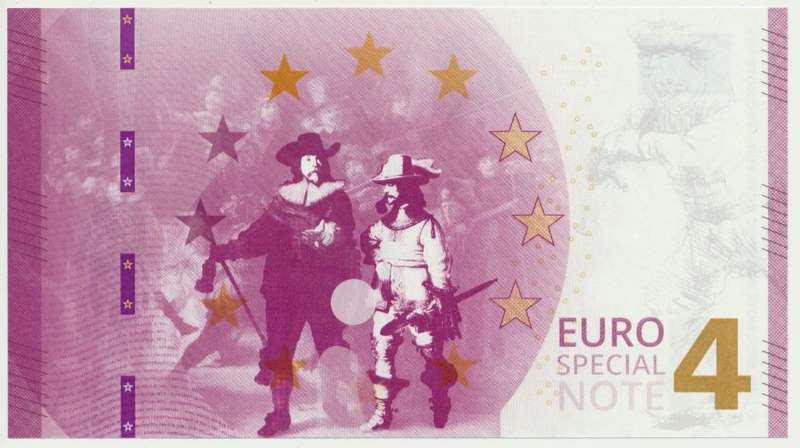
The back of this Euro Special Note features Rembrandt's most famous painting: The Night Watch. Rembrandt painted The Night Watch between about 1640 and 1642. The Night Watch was only later called The Night Watch. Earlier it was called The Corporal Company of Frans Banning Cocq and Lieutenant Willem Ruytenburgh makes ready. Around 1796-1797, the painting was first called The Night Watch. The Night Watch had been commissioned for the new Kloveniersdoelen, gathering place for the musketeers of various militia. Rembrandt depicted The Night Watch differently than was normal at the time. These militia pieces were usually depicted stiffly and formally. It is now more of an action scene than a setup. He showed part of the civic guard of district II, from between the Damrak and the Nieuwendijk. They are getting ready at the gate and want to advance with lances or pikes raised.
The painting The Night Watch, which now hangs in the Rijksmuseum Amsterdam, was originally larger. The Night Watch was shortened on all four sides around 1715 to make the painting fit for the Little Warrior's Room of the then Town Hall on Dam Square. Since then, the painting has measured 363 cm by 438 cm.
The bill does not come from an ordinary color printer, with ordinary paper, assures Euro Special Note.
The bills were developed and issued with authorization from the European Central Bank (ECB) and De Nederlandsche Bank (DNB).
The bills contain several official security features that banknotes also have, such as a watermark, microtext, unique serial number,
holographic foil, fluorescent fibers and invisible ink that lights up under UV light.
The bill is not actually spendable.
See scans for more details.
For questions feel free to send us a message.




 English
  Dutch
Dutch  French
  German
  Chinese
  Russian
  Arabic